
The Complete Guide to Website Audits: 8 Essential Types

Your website serves as the cornerstone of your online presence. But how do you know if it's performing at its peak? The answer lies in conducting comprehensive website audits.
Think of a website audit as a health check-up for your digital presence—a systematic evaluation that uncovers hidden issues, identifies opportunities for improvement, and ensures your site is aligned with both user expectations and search engine requirements.
Website audits have evolved significantly beyond simple SEO checks. Modern businesses require multiple types of audits to address various aspects of website performance, from user experience to security vulnerabilities. This comprehensive guide explores eight essential types of website audits that every business should consider implementing as part of their digital strategy.
1. SEO Audits: The Foundation of Search Visibility
Search Engine Optimization (SEO) audits remain the most common type of website audit, and for good reason. They analyze how well your website is optimized to achieve higher rankings on search engines like Google and Bing.
What SEO Audits Cover
An SEO audit examines numerous factors that influence your search engine rankings:
- Keyword optimization: Analyzing keyword density, relevance, and strategic placement throughout your content
- Meta data assessment: Reviewing title tags, meta descriptions, and header tags for optimization opportunities
- Content quality evaluation: Assessing content relevance, depth, and user value
- Internal linking structure: Examining how pages connect to each other and how link equity flows through your site
- Backlink profile analysis: Reviewing the quality and quantity of external links pointing to your website
- Technical SEO factors: Checking site architecture, URL structure, and crawlability
Key Benefits and Industry Impact
SEO audits help identify why your website might not be ranking well for target terms and phrases. They reveal opportunities to improve keyword density, add more relevant content, and enhance off-page SEO through better backlink strategies. The impact is significant: 91% of marketers reported that SEO had a positive impact on their website performance, and the average return on investment (ROI) for a high-quality SEO campaign is 748%, meaning every dollar spent on SEO yields an average of $7.48 in return.
Who Typically Conducts SEO Audits
E-commerce businesses represent the largest segment conducting SEO audits, as they rely heavily on organic search traffic to drive product discovery and sales. Online retailers understand that ranking higher for product-related keywords directly correlates with revenue, making regular SEO audits essential for maintaining competitive advantage. These businesses often conduct comprehensive audits quarterly to identify technical issues, optimize product pages, and improve their overall search visibility.
Service-based businesses such as law firms, dental practices, consulting agencies, and local service providers also heavily invest in SEO audits. For these businesses, appearing in local search results can make or break their success, as 18% of local searches result in a purchase within 24 hours. Professional services particularly benefit from SEO audits because they help establish authority and trust, which are crucial factors in their industries.
For businesses seeking comprehensive SEO audit services, Custom Web Audits brings over 10 years of experience and has completed more than 1000 audits across diverse industries. Their team specializes in identifying critical SEO issues that others might miss, providing actionable recommendations that drive measurable improvements in search rankings and organic traffic.
According to WordStream's comprehensive audit checklist, effective SEO audits require access to tools like Google Analytics, Google Search Console, and specialized SEO software to gather deeper insights into backlinks, competitive information, and keyword data.
2. Technical Audits: The Behind-the-Scenes Performance
Technical audits focus on the infrastructure and backend elements that affect your website's functionality and search engine accessibility. These audits are crucial for identifying issues that occur "behind the scenes" but significantly impact user experience and search rankings.
Core Technical Elements
Technical audits examine several critical areas:
- Site architecture and navigation: Ensuring logical structure and easy crawlability for search engines
- Page loading speed: Analyzing factors that affect site performance and user experience
- Mobile responsiveness: Verifying that your site functions properly across all devices
- Server configuration: Checking hosting performance, uptime, and server response times
- URL structure: Ensuring clean, SEO-friendly URLs that are properly formatted
- XML sitemaps: Verifying that search engines can easily discover and index your content
- Robots.txt files: Checking that search engine crawlers can access the right pages
The Impact of Technical Issues
Technical problems can severely impact your website's visibility and user experience. Issues like broken links, slow loading times, or improper redirects can cause search engines to penalize your site or users to abandon it entirely. The statistics are alarming: over 30,000 vulnerabilities were disclosed in 2024, a 17% increase from previous figures, highlighting the growing need for regular technical audits. Additionally, slow-loading websites result in a 123% higher bounce probability when mobile load time increases from 1s to 10s.
Who Typically Conducts Technical Audits
SaaS companies and tech startups are among the most frequent users of technical audits, as their business models depend entirely on flawless technical performance. These organizations understand that even minor technical issues can lead to customer churn, reduced user satisfaction, and ultimately, decreased revenue. They often conduct technical audits monthly or quarterly to ensure optimal performance, especially during high-growth phases when technical debt can accumulate quickly.
Large enterprise websites with complex infrastructures, multiple integrations, and high traffic volumes also regularly perform technical audits. These organizations typically have substantial technical teams but still benefit from external audits to identify blind spots and ensure compliance with industry standards. Banks, healthcare providers, and multinational corporations especially prioritize technical audits due to regulatory requirements and the critical nature of their online operations.
Custom Web Audits has extensive experience conducting technical audits for complex enterprise environments and fast-growing startups alike. Their technical audit process covers over 140 potential issues, from server configuration problems to mobile responsiveness issues, ensuring no technical stone is left unturned.
As noted by Tao Digital Marketing, technical audits are essentially a specialized type of SEO audit that focuses on behind-the-scenes functionality that directly impacts organic performance.
3. Content Audits: Evaluating Your Digital Voice
Content audits provide a comprehensive review of all textual, visual, and multimedia elements on your website. They assess whether your content effectively communicates your brand message, engages your target audience, and supports your business objectives.
Content Audit Components
A thorough content audit evaluates:
- Content quality and relevance: Assessing whether content meets user needs and business goals
- Content freshness: Identifying outdated information that needs updating or removal
- Content gaps: Finding opportunities to create new content that addresses user queries
- Image and video optimization: Ensuring multimedia elements load quickly and include proper alt tags
- Content organization: Reviewing how information is structured and presented
- Call-to-action effectiveness: Analyzing whether CTAs are clear, compelling, and strategically placed
Strategic Content Improvements and Industry Impact
Content audits often reveal that images and videos need optimization due to slow loading times, or that certain pages lack sufficient content depth. This provides perfect opportunities to introduce new pages, blog posts, or multimedia content that better serves your audience. The business impact is significant: 33% of marketers conduct a content audit twice a year, and companies using content marketing see conversion rates that are 6 times higher than those that don't. Additionally, 83% of marketers say it's better to focus on quality rather than quantity of content, even if it means posting less often.
Who Typically Conducts Content Audits
B2B technology companies and professional service firms frequently conduct content audits as part of their lead generation strategy. These businesses rely heavily on educational content, whitepapers, case studies, and thought leadership articles to attract and nurture prospects through complex sales cycles. With 94% of B2B marketers creating short articles and blog posts, regular content audits help ensure their extensive content libraries remain relevant, discoverable, and effective at converting visitors into qualified leads.
Media companies, publishers, and content-heavy websites such as news sites, educational platforms, and online magazines conduct content audits to maintain editorial quality and optimize for search visibility. These organizations often manage thousands of content pieces and need systematic approaches to identify underperforming content, update outdated information, and maintain content freshness. They particularly benefit from content audits because search engines favor websites that regularly update and improve their content.
Custom Web Audits specializes in comprehensive content audits that go beyond basic content review to include content performance analysis, competitor content gap analysis, and strategic content recommendations. Their decade of experience has helped clients identify content opportunities that resulted in significant improvements in organic traffic and user engagement.
According to Mailchimp's audit guide, content audits may also identify the need for stronger internal linking strategies to help both users and search engines navigate your site more efficiently.
4. Design and User Experience (UX) Audits
Design audits evaluate your website's visual elements, layout, and overall user experience to ensure optimal usability and conversion potential. These audits focus on how visitors interact with your site and whether the design facilitates their goals.
Design Audit Focus Areas
UX design audits examine multiple aspects of user interaction:
- Visual hierarchy: Ensuring the most important elements draw appropriate attention
- Navigation usability: Testing whether users can easily find what they're looking for
- Mobile experience: Verifying responsive design across different screen sizes
- Brand consistency: Checking that design elements align with your brand identity
- Form functionality: Testing contact forms, checkout processes, and user input fields
- Loading performance: Analyzing how design elements affect page speed
- Accessibility considerations: Ensuring the design accommodates users with disabilities
User Journey Analysis and Business Impact
Design audits should assess the complete customer journey to identify friction points where users might struggle or abandon their goals. This includes examining the checkout process for e-commerce sites, lead generation forms, and overall site navigation patterns. The return on investment is substantial: a well-designed UI can increase a website's conversion rate by up to 200%, and a better UX design can achieve conversion rates of up to 400%. Additionally, 88% of online users are less likely to return to a website after a bad user experience, emphasizing the critical importance of regular UX audits.
Who Typically Conducts Design and UX Audits
E-commerce platforms and online retailers prioritize UX audits because their success depends entirely on providing seamless shopping experiences. These businesses understand that even small design improvements can significantly impact conversion rates and average order values. With the shopping cart abandonment rate on mobile being 77.8% compared to 67.1% on desktop, e-commerce companies regularly conduct UX audits to identify and eliminate friction points in their purchase funnels.
Financial services companies and fintech startups also heavily invest in UX audits due to the complex nature of financial products and the high trust requirements in their industry. These organizations need to balance security requirements with user-friendly design, making UX audits essential for ensuring their applications remain both secure and intuitive. The stakes are particularly high in fintech, where 75% of users admit to making judgments about a company's credibility based on their website's design.
Custom Web Audits combines technical expertise with design sensibility to deliver UX audits that identify both obvious usability issues and subtle design problems that might be impacting user behavior. Their comprehensive approach examines user flows, interaction patterns, and conversion paths to provide actionable recommendations for improving the overall user experience.
UX4Sight's comprehensive design audit guide emphasizes that effective design audits compare your site to both user research and competitor analysis to identify opportunities for improvement.
5. Performance and Core Web Vitals Audits
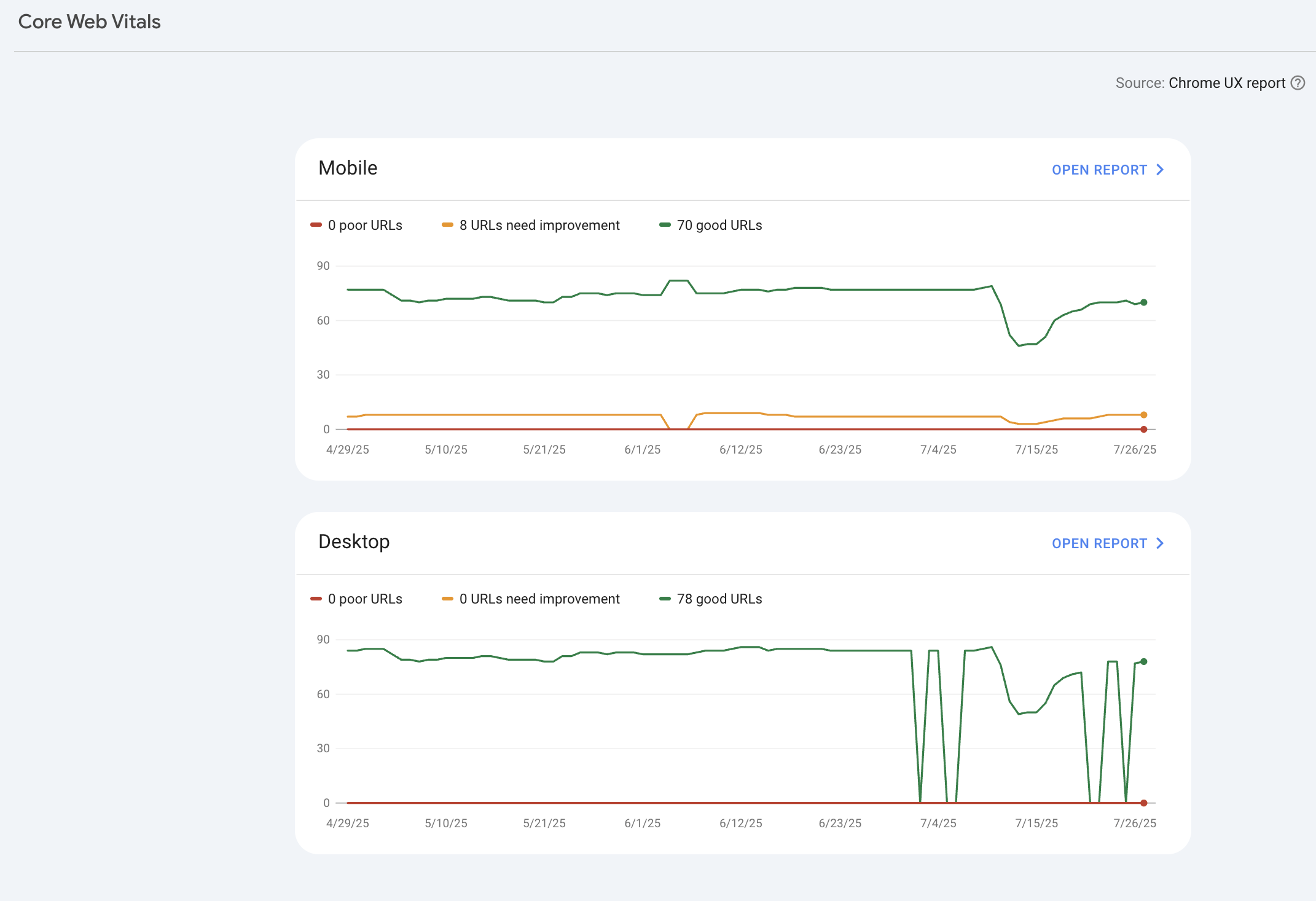
Performance audits have gained critical importance, especially with Google's emphasis on Core Web Vitals as ranking factors. These audits measure how quickly and smoothly your website loads and responds to user interactions.
Core Web Vitals Metrics
Modern performance audits focus on three essential Core Web Vitals:
- Largest Contentful Paint (LCP): Measures loading performance, ideally under 2.5 seconds
- Interaction to Next Paint (INP): Measures responsiveness to user interactions, ideally under 200 milliseconds
- Cumulative Layout Shift (CLS): Measures visual stability as the page loads, ideally under 0.1
Performance Optimization Areas and Industry Impact
Performance audits identify numerous factors that affect site speed:
- Image optimization: Compressing images and using modern formats like WebP
- Code minification: Reducing CSS, JavaScript, and HTML file sizes
- Server response times: Improving hosting performance and database queries
- Caching strategies: Implementing browser and server-side caching
- Third-party script impact: Analyzing how external tools affect loading times
The performance impact on business metrics is dramatic: bounce risk jumps 123% when mobile load time increases from 1s to 10s, and 53% of mobile users abandon sites that take more than 3 seconds to load. Furthermore, only a third of websites currently meet Core Web Vitals standards, presenting massive opportunities for businesses that prioritize performance optimization.
Who Typically Conducts Performance Audits
Media and publishing companies with content-heavy websites frequently conduct performance audits because their success depends on delivering content quickly across various devices and connection speeds. News sites, online magazines, and educational platforms particularly benefit from performance audits as slow loading times directly correlate with higher bounce rates and reduced ad revenue. These organizations often have complex content management systems and multiple third-party integrations that can impact performance.
E-commerce businesses and online marketplaces prioritize performance audits because page speed directly affects conversion rates and revenue. Studies show that even a one-second delay in page load time can result in a 7% reduction in conversions. Large e-commerce platforms with thousands of product pages and high-resolution images need regular performance audits to ensure optimal shopping experiences across all devices, especially mobile where the majority of shopping now occurs.
For comprehensive performance optimization, Custom Web Audits provides detailed Core Web Vitals analysis and actionable recommendations for improving site speed. Their performance audits have helped clients achieve significant improvements in loading times, leading to measurable increases in user engagement and conversions.
According to the 2025 Core Web Vitals Technology Report, Google continues to place increasing emphasis on these metrics for search rankings, making performance audits essential for competitive advantage.
6. Accessibility Audits: Ensuring Inclusive Design
Accessibility audits assess whether your website can be used by people with various disabilities and whether it complies with accessibility guidelines like the Web Content Accessibility Guidelines (WCAG).
WCAG Compliance Levels
Accessibility audits typically focus on WCAG 2.1 or 2.2 standards with three conformance levels:
- Level A: Basic accessibility compliance (minimum standard)
- Level AA: Standard compliance required by most laws and regulations
- Level AAA: Enhanced compliance (highest standard, often not required)
Key Accessibility Elements
Comprehensive accessibility audits examine:
- Screen reader compatibility: Ensuring content is properly structured for assistive technologies
- Keyboard navigation: Verifying all functionality is accessible without a mouse
- Color contrast ratios: Checking that text meets minimum contrast requirements
- Alt text for images: Ensuring all images have descriptive alternative text
- Video captions: Providing text alternatives for audio content
- Form accessibility: Making sure forms are properly labeled and functional with assistive technology
Legal and Business Implications
The current state of web accessibility is concerning: 96.3% of the top million homepages did not comply with ADA standards, each exhibiting an average of 50.0 barriers to accessibility. Furthermore, the end of 2024 saw a 7% increase in ADA lawsuits against organizations, with a total of 8,800 ADA Title III complaints filed. The European Accessibility Act (EAA) will come into effect in June 2025, significantly expanding accessibility requirements globally.
Who Typically Conducts Accessibility Audits
Government agencies and public sector organizations are legally mandated to conduct accessibility audits under various accessibility laws. Federal, state, and local government websites must comply with Section 508 and ADA Title II requirements, making regular accessibility audits essential for legal compliance. These organizations often conduct accessibility audits quarterly or semi-annually to ensure ongoing compliance, especially when updating content or launching new digital services.
Large corporations and enterprises across industries including healthcare, finance, retail, and education increasingly prioritize accessibility audits to mitigate legal risk and expand their market reach. With 77% of ADA lawsuits in 2023 targeting companies with under $25 million in revenue, businesses of all sizes recognize the importance of proactive accessibility compliance. These organizations understand that accessible design benefits all users and can improve overall user experience and SEO performance.
Custom Web Audits provides comprehensive WCAG compliance audits that go beyond automated scanning to include manual testing and real user testing with assistive technologies. Their accessibility experts have helped organizations across various industries achieve and maintain compliance while improving usability for all users.
As noted by AudioEye's WCAG audit guide, accessibility compliance isn't just about following guidelines—it's about avoiding legal risks from ADA, EAA, and similar accessibility laws while expanding your potential audience to include the estimated 1.3 billion people worldwide who live with disabilities.
7. Security Audits: Protecting Your Digital Assets
Security audits evaluate your website's vulnerability to cyber attacks and ensure that sensitive data is properly protected. With cyber threats becoming increasingly sophisticated, regular security assessments are essential for any business with an online presence.
Security Audit Components
Comprehensive security audits examine:
- SSL/TLS certificate configuration: Ensuring proper encryption for data transmission
- Software vulnerabilities: Checking for outdated plugins, themes, and core files
- Authentication systems: Reviewing password policies and multi-factor authentication
- Access controls: Ensuring proper user permissions and role-based access
- Data protection measures: Verifying secure handling of customer information
- Malware detection: Scanning for existing infections or suspicious code
- Server security: Assessing hosting environment and server configurations
Common Vulnerabilities and Growing Threats
Security audits often uncover issues such as:
- SQL injection vulnerabilities
- Cross-site scripting (XSS) flaws
- Weak password policies
- Outdated software components
- Insecure cookie configurations
- Missing security headers
- Open admin ports
The cybersecurity landscape is becoming increasingly dangerous: there are 2,200 cyber attacks per day, with a cyber attack happening every 39 seconds on average. Moreover, in the first half of 2025, CVE reports continued to rise, with about 131 CVEs published daily, compared to 113 per day in 2024. The financial impact is staggering, with cybercrime projected to cost companies worldwide $10.5 trillion annually in 2025.
Who Typically Conducts Security Audits
Financial institutions and fintech companies conduct the most rigorous and frequent security audits due to regulatory requirements and the sensitive nature of financial data they handle. Banks, credit unions, payment processors, and investment firms are required to undergo security audits quarterly or even monthly to comply with regulations like PCI DSS, SOX, and various banking regulations. These organizations understand that a single security breach could result in massive financial losses, regulatory fines, and irreparable damage to customer trust.
Healthcare organizations and medical technology companies also prioritize security audits due to HIPAA compliance requirements and the highly sensitive nature of patient data. Hospitals, clinics, medical device manufacturers, and healthcare software providers conduct regular security audits to protect patient privacy and avoid potentially devastating compliance violations. The healthcare sector has become a prime target for cybercriminals, making comprehensive security audits essential for maintaining patient trust and avoiding costly data breaches.
Custom Web Audits offers comprehensive security audits that examine both technical vulnerabilities and human factors that could compromise website security. Their security audit process includes penetration testing, vulnerability assessments, and security policy reviews to provide a complete picture of an organization's security posture.
According to GetAstra's security audit guide, the most reliable web security audits combine automated tools with manual testing to provide comprehensive vulnerability assessment and management.
8. Conversion Rate Optimization (CRO) Audits
CRO audits focus specifically on how well your website converts visitors into customers, leads, or desired actions. These audits analyze user behavior and identify opportunities to improve conversion rates.
CRO Audit Elements
Conversion audits examine:
- Landing page effectiveness: Analyzing how well pages convert traffic from different sources
- Call-to-action performance: Testing button placement, design, and messaging
- Form optimization: Reducing friction in lead generation and checkout processes
- User flow analysis: Identifying where visitors drop off in conversion funnels
- A/B test opportunities: Finding elements that could benefit from testing
- Trust signals: Ensuring proper placement of testimonials, security badges, and guarantees
Behavioral Analysis and Business Impact
CRO audits often utilize tools like heat maps, session recordings, and user testing to understand how visitors actually interact with your website, revealing gaps between intended design and actual user behavior. The potential for improvement is significant: the global average website conversion rate is 3.68%, while top-performing websites achieve 11% or higher. Additionally, companies using CRO tools see an average ROI of 223%, and a well-designed UI can increase conversion rates by up to 200%, while improved UX can increase conversions by up to 400%.
The conversion rate optimization market is experiencing significant growth, with the CRO software market valued at $1.98 billion in 2022 and projected to grow at a CAGR of 5.16%, reaching $2.83 billion by 2029.
Who Typically Conducts CRO Audits
E-commerce businesses and online retailers are the primary users of CRO audits because conversion rate directly impacts their revenue. These businesses understand that improving conversion rates is often more cost-effective than increasing traffic, as it maximizes the value of existing marketing investments. With the average cart abandonment rate being 70% across all industries, e-commerce companies regularly conduct CRO audits to identify and eliminate barriers in their checkout processes.
SaaS companies and subscription-based businesses heavily invest in CRO audits because their business models depend on converting trial users to paid subscribers and optimizing their pricing pages. These organizations focus on optimizing their entire customer journey, from initial sign-up through onboarding and upgrade paths. The statistics show that 46.9% of optimizers run one or two CRO tests monthly, while only 9.5% of companies run 20+ monthly tests, indicating significant opportunities for businesses willing to invest in systematic conversion optimization.
Custom Web Audits specializes in comprehensive CRO audits that combine quantitative data analysis with qualitative user research to identify conversion barriers and opportunities. Their CRO audit process examines the entire conversion funnel and provides prioritized recommendations for improving conversion rates across different traffic sources and user segments.
HubSpot's website audit guide emphasizes the importance of analyzing abandoned shopping carts and form submissions to identify specific friction points in the conversion process.
Why Choose Professional Website Audit Services
While understanding the different types of audits is crucial, executing comprehensive audits requires specialized expertise, advanced tools, and significant time investment. This is where professional audit services become invaluable for businesses seeking thorough, actionable insights.
Custom Web Audits stands out as a leader in comprehensive website audit services, bringing over 10 years of specialized experience and having completed more than 1000 audits across diverse industries and business sizes. Their team combines technical expertise with strategic insight to deliver audits that go beyond identifying problems—they provide clear roadmaps for improvement and measurable results.
What sets Custom Web Audits apart is their holistic approach that examines all eight audit types within an integrated framework. Rather than treating each audit type as a separate service, they understand how SEO, technical performance, content quality, user experience, accessibility, security, and conversion optimization work together to impact overall website effectiveness. This comprehensive perspective often reveals interconnected issues that individual audits might miss.
Their decade of experience has enabled Custom Web Audits to develop proprietary methodologies and automated processes that ensure consistency and thoroughness across every engagement. Whether you're a startup needing your first comprehensive audit or an enterprise requiring ongoing audit services, their scalable approach adapts to your specific needs and industry requirements.
Planning Your Website Audit Strategy
Determining Audit Frequency
Different types of audits require different frequencies:
- SEO and technical audits: Quarterly or bi-annually
- Security audits: Monthly or quarterly, depending on your risk profile
- Performance audits: Monthly or after major updates
- Content audits: Bi-annually or annually
- Design and accessibility audits: Annually or during redesign projects
- CRO audits: Quarterly or when conversion rates decline
Choosing the Right Tools
Successful website audits require the right combination of tools:
- Free tools: Google Analytics, Google Search Console, PageSpeed Insights, WAVE accessibility checker
- Premium tools: SEMrush, Ahrefs, Screaming Frog, Lighthouse, specialized security scanners
- Professional services: Consider hiring experts for complex audits or when internal resources are limited
Implementing Audit Findings
The value of any audit lies in acting on its findings. Optimizely's audit implementation guide recommends:
- Prioritizing issues: Focus on problems that affect the most users or have the highest business impact
- Creating action plans: Develop specific, measurable steps for addressing each issue
- Setting deadlines: Establish realistic timelines for implementing changes
- Measuring results: Track improvements using relevant metrics
- Scheduling follow-ups: Plan regular re-audits to ensure continued optimization
The Future of Website Audits
As technology evolves, website audits are becoming more sophisticated. Emerging trends include:
- AI-powered analysis: Automated tools that provide deeper insights and recommendations
- Real-time monitoring: Continuous auditing rather than periodic assessments
- Integration with business metrics: Connecting technical performance to revenue and business outcomes
- Enhanced accessibility standards: Evolving WCAG guidelines and legal requirements
- Privacy and compliance audits: Increasing focus on GDPR, CCPA, and other data protection regulations
You Need an Audit Now!
Website audits are no longer optional in today's competitive digital landscape—they're essential for maintaining a high-performing, secure, and user-friendly online presence. By implementing regular audits across all eight categories discussed in this guide, businesses can ensure their websites not only meet current standards but are prepared for future changes in technology and user expectations.
The key to successful website auditing lies in understanding that these different audit types work together synergistically. A fast-loading site (performance audit) with great content (content audit) and solid security (security audit) will naturally perform better in search results (SEO audit) and provide better user experiences (UX audit).
Whether you choose to conduct these audits internally or work with professional services like Custom Web Audits, the investment in regular website auditing will pay dividends in improved user satisfaction, better search rankings, enhanced security, and ultimately, stronger business performance. With their decade of experience and over 1000 completed audits, Custom Web Audits offers the expertise and comprehensive approach needed to transform audit insights into measurable business results.
Start with the audit type that aligns most closely with your current business challenges, but remember that comprehensive website optimization requires attention to all these areas over time. Regular auditing, combined with consistent implementation of recommendations, will ensure your website continues to serve as an effective tool for achieving your business objectives.
The digital landscape will continue to evolve, but businesses that prioritize systematic website auditing will be best positioned to adapt, compete, and succeed in an increasingly complex online environment.
See exactly what's hurting your website
Start free with our instant SEO tools — or run the all-in-one audit: SEO, speed, accessibility, content, AI visibility & conversion, in one report.